
Darlinghurst NSW 2010

Sharps and body fluid boundaries for cleaning staff in Darlinghurst premises

Sooner or later a cleaner in an inner-city building finds something they should not handle: a discarded sharp in a washroom, a spill of unknown origin in a stairwell. What happens next should have been decided months earlier, in writing, by people who were not under pressure at the time.

In short

General cleaning contractors are not clinical waste handlers. Discarded sharps, unidentified body fluids and clinical material require a defined response that depends on the premises, and the site should have that procedure in place before the situation arises rather than improvising when it does.

Clean Best states the boundary in the written scope: what our cleaners do, what they secure and report, and what requires the site's own procedure or a specialist service. Cleaners are briefed to report and isolate rather than improvise, and the site's contact for that situation is recorded before the first shift.

Why the boundary has to be written before it is needed

In the moment, a cleaner faces a bad choice: leave a hazard in a public washroom, or handle something they are not equipped for. Both are poor outcomes and both arise from the same omission, which is that nobody decided in advance. Written boundaries convert an individual judgement under pressure into following a procedure, which is the entire point of having one.

The boundary also protects the client. A cleaner injured handling a discarded sharp in your building is a serious event with consequences well beyond the cleaning arrangement. A site that can show it defined the response, provided the means to isolate a hazard and named a contact has a materially different position from one that relied on a cleaner's initiative at midnight.
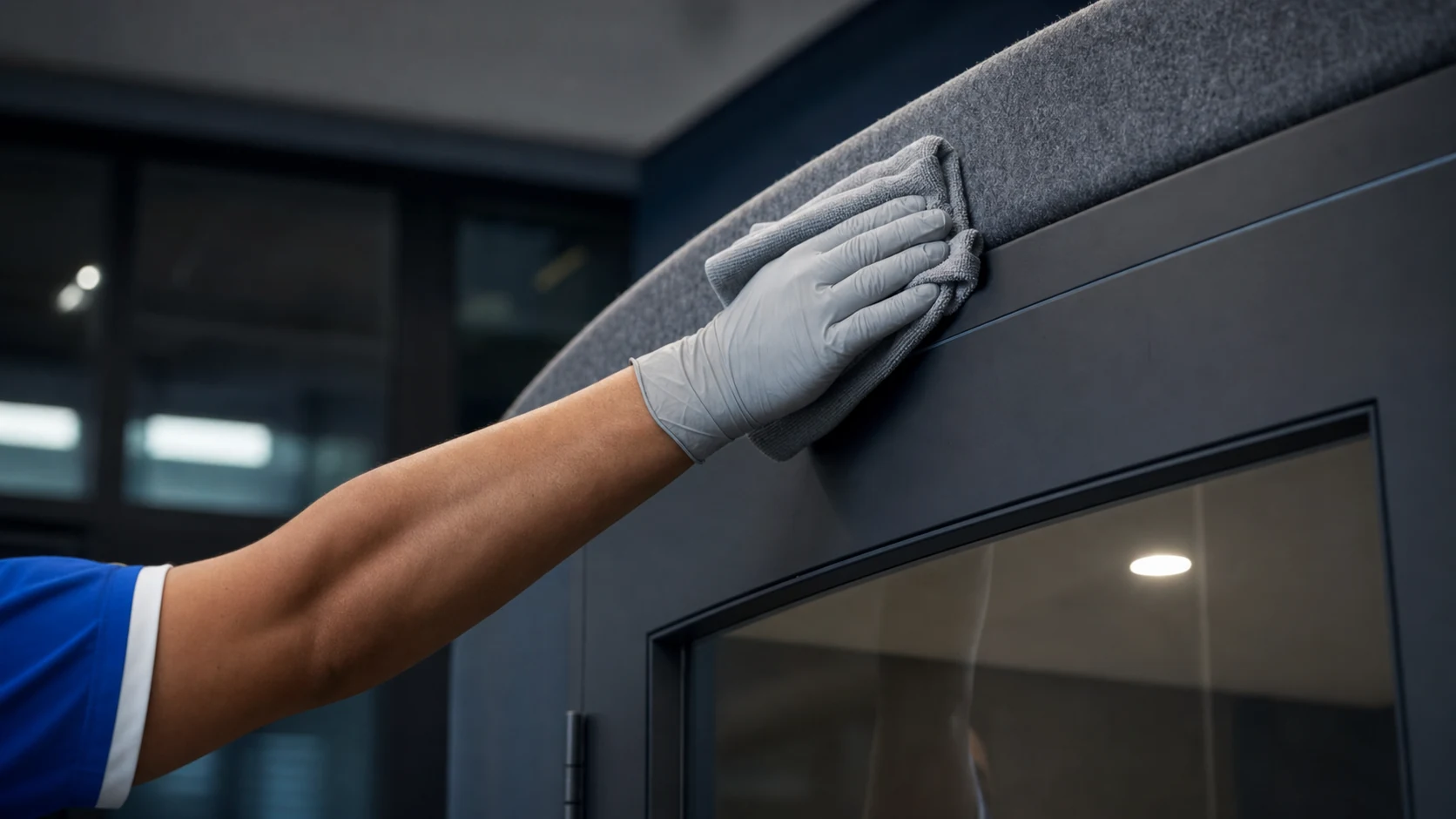
What a workable procedure contains

Four elements. What the cleaner does immediately: stop, do not handle, prevent access. How the area is isolated: signage, a closed door, a barrier that the site has actually provided. Who is contacted, with a number that answers at the hour cleaning occurs. And what happens next, which may be a site response, a specialist service or a clinical staff member depending on the premises.

The equipment matters as much as the instruction. Telling a cleaner to isolate an area is meaningless if there is nothing to isolate it with. A washroom that can be locked, a folding sign, or even a taped notice should be available and its location known. Sites frequently write the procedure and omit this step, which leaves the cleaner improvising anyway. Sites that provide the equipment but do not tell the cleaner where it is stored have solved half the problem and left the harder half in place.

Premises where this comes up most

Publicly accessible washrooms in hospitality venues and mixed-use buildings account for a large share of these situations, more than clinical rooms where the material is expected and managed. Stairwells, car parks, rear laneway entrances and any area with unsupervised public access follow. A building's risk here is driven by accessibility rather than by its stated use. Buildings with rear laneway entrances and unattended stairwells sit in the same category, even where the tenancy itself is an ordinary office.

That is worth stating because a general office with a publicly reachable washroom needs the procedure as much as a clinic does, and is far less likely to have one. Clean Best raises the question at the walkthrough for any premises with public access, because the sites that most need the procedure are usually the ones that have never considered it necessary.

Sharps and spill procedure for a Darlinghurst site

  • Written statement of what the cleaner does and does not handle
  • Immediate actions: stop, do not handle, prevent access
  • Isolation equipment actually available on site, with its location known
  • Contact who answers at the hours cleaning occurs
  • Named responder or service for removal, appropriate to the premises
  • Record of each occurrence, reviewed for patterns rather than filed
Clean Best supervisor completing an office cleaning quality check in NSW

Working in Darlinghurst and the Inner City

Darlinghurst in the Inner City holds healthcare premises, hospitality venues, retail and professional suites in dense streets with a high level of public access and long trading hours. Buildings here frequently have washrooms reachable from the street, rear entrances onto laneways and stairwells shared between tenancies, all of which raise the likelihood of a cleaner encountering something outside ordinary cleaning. Clean Best services Darlinghurst from Seven Hills and agrees the response procedure and contact before the first shift rather than after the first occurrence.

Questions about Darlinghurst

Should a cleaner ever pick up a discarded sharp?

Not as a general cleaning task. The safe response is to stop, prevent access to the area and contact the site's nominated responder. Some premises equip and train specific staff for this and have a defined procedure with the correct containers; a general cleaning contractor working alone at night is a different situation and should not be improvising.

Who removes clinical or unidentified material?

That depends on the premises. Clinical settings have their own procedures and staff; other buildings may use a specialist service. What matters is that the answer exists and the contact is reachable at the hour cleaning occurs. A procedure naming a person who works business hours only is not a procedure for a night shift.

Does this belong in the cleaning scope or the site's safety plan?

Both, and they should say the same thing. The scope records what the cleaner does and does not do; the site's own plan records the response. Where the two documents differ, the cleaner follows the more cautious course, but the better outcome is noticing the discrepancy during mobilisation rather than during an event.

What if the same washroom produces repeated occurrences?

Then it is a building issue rather than a cleaning issue, and the record should drive a decision. Options usually involve access control, layout, disposal provision or supervision, none of which are within a cleaning contractor's gift. Recording each occurrence with date and location is what makes the pattern visible enough to act on.

Does a general office need this procedure?

If its washrooms or stairwells are reachable by the public, yes. Accessibility drives the risk more than the building's stated use, and offices with street-accessible facilities are among the least likely to have considered it. The procedure is short, costs nothing to write, and is only needed on the night it is genuinely needed.

Get a fixed written quote for Darlinghurst

Free walkthrough, scope in writing, price back within 24 hours.

Request a quote
Call nowEmail us